DJI Zenmuse L2 (Risley Prism Scanner)
Notebook: Thomas Isensee & Hannah Weiser, 2026
This demo notebook uses the DJI Zenmuse L2 laser scanner, which is based on a risley beam deflector with three prisms. It has two scan modes, one that results in a repetitive scan pattern and one that results in a non-repetitive scan pattern.
[1]:
import helios
import matplotlib.pyplot as plt
import copy
Scene
We use a simple scene, consisting of a cubix box (box100.obj) of 100 x 100 x 100 units, which is centered at the origin O(0,0,0). We like to use this scene for debugging purposes, because no shots get lost when scanning from within the box and the planar surfaces allow to assess the scan pattern.
[2]:
box = helios.ScenePart.from_obj("../data/sceneparts/basic/box/box100.obj")
scene = helios.StaticScene(scene_parts=[box])
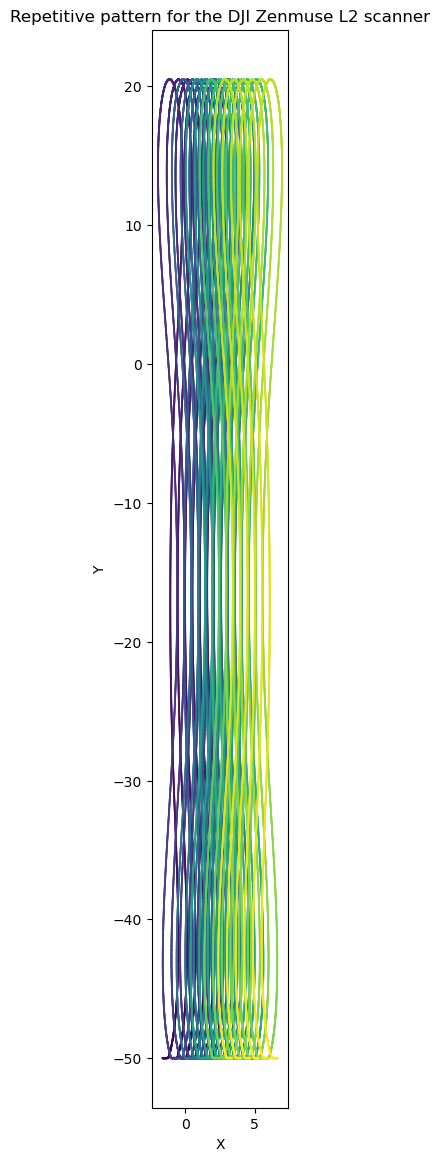
Survey 1: Repetitive scan pattern
Here, we simulate a simple linear path survey with a single leg, which moves at 50 m/s for 5 m along the x-axis.
[3]:
scanner = helios.scanner_from_name("dji_zenmuse_l2_repetitive")
platform = helios.platform_from_name("sr22")

survey = helios.Survey(scanner=scanner, platform=platform, scene=scene)

survey.add_leg(x=0.0, y=-15.0, z=0.0, speed_m_s=50)
survey.add_leg(x=5.0, y=-15.0, z=0.0, speed_m_s=50)
We use the DJI Zenmuse L2, defined in python/helios/data/scanners_als.xml, with the repetitive scan pattern (dji-zenmuse-l2-repetitive). For this deflector type, the scan pattern is controlled by the rotation speeds (rotorFreq1_Hz and rotorFreq2_Hz, rotorFreq3_Hz) of three rotating risley prisms. This design is described in detail in Qin et al. (2024).
Executing the survey
[4]:
points, trajectories = survey.run(
    verbosity=helios.LogVerbosity.VERBOSE, format=helios.OutputFormat.NPY
)
Visualizing the results
Now we can display the point cloud.
[5]:
fig, ax = plt.subplots(1, 1, figsize=(6, 14))
pos = points["position"]

ax.scatter(pos[:, 0], pos[:, 1], s=0.1, c=points["gps_time"])
ax.set_ylabel("Y")
ax.set_xlabel("X")
ax.set_title("Repetitive pattern for the DJI Zenmuse L2 scanner")
ax.set_aspect("equal", "box")

plt.show()
Survey 2: Non-repetitive scan pattern
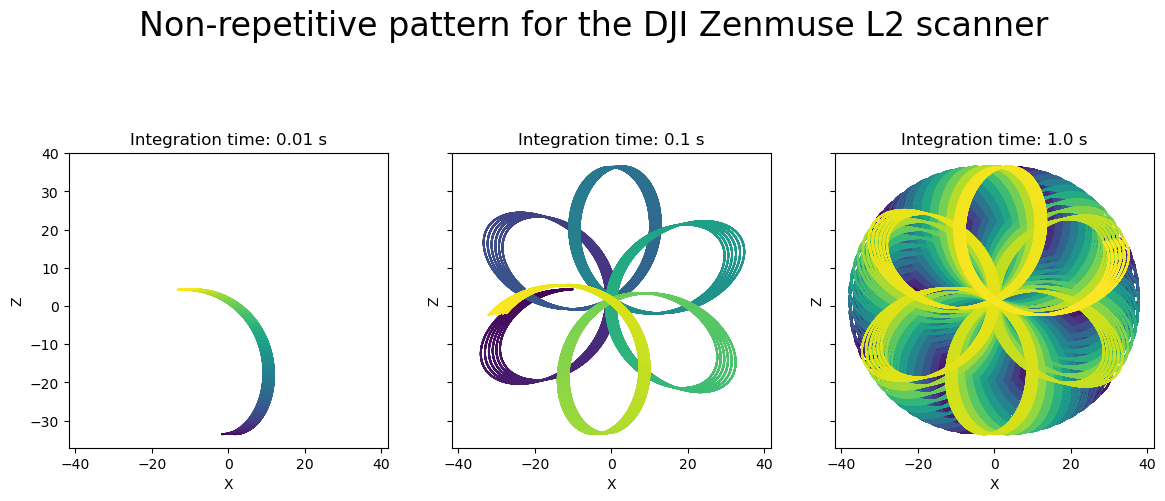
The same scanner can be used in a second mode, which results in a non-repetitive scan pattern. The difference in the pattern is the result of different rotor frequencies for the three prisms.
[6]:
scanner = helios.scanner_from_name("dji_zenmuse_l2_non_repetitive")
platform = helios.platform_from_name("tripod")

survey = helios.Survey(scanner=scanner, platform=platform, scene=copy.deepcopy(scene))
For the non-repetitive scan pattern, we will use a static survey and different integration times to demonstrate the characteristics of the pattern, similar to the 9-tls_livox_demo example. There add three legs corresponding to three scan positions (SPs) at the origin O(0, 0, 0). Using the max_duration parameter, we can control how long the integration time (scanning time) is at each SP. With increasing integration time, we get a higher point density and the density is highest in
the center of the retina-like scan pattern.
[7]:
x = y = z = 0.0
survey.add_leg(x=x, y=y, z=z, max_duration=0.01 * helios.units.s)
survey.add_leg(x=x, y=y, z=z, max_duration=0.1 * helios.units.s)
survey.add_leg(x=x, y=y, z=z, max_duration=1.0 * helios.units.s)
Executing the survey
[8]:
points, trajectories = survey.run(
    verbosity=helios.LogVerbosity.VERBOSE, format=helios.OutputFormat.NPY
)
Visualizing the results
Now we can display the point cloud.
[9]:
fig, (ax1, ax2, ax3) = plt.subplots(1, 3, figsize=(14, 6), sharex=True, sharey=True)

points_1 = points[points["point_source_id"] == 0]
points_2 = points[points["point_source_id"] == 1]
points_3 = points[points["point_source_id"] == 2]
sp_1 = points_1["position"]
sp_2 = points_2["position"]
sp_3 = points_3["position"]

ax1.scatter(sp_1[:, 0], sp_1[:, 2], s=0.1, c=points_1["gps_time"])
ax1.set_xlabel("X")
ax1.set_ylabel("Z")
ax1.set_title("Integration time: 0.01 s")

ax2.scatter(sp_2[:, 0], sp_2[:, 2], s=0.1, c=points_2["gps_time"])
ax2.set_xlabel("X")
ax2.set_ylabel("Z")
ax2.set_title("Integration time: 0.1 s")

ax3.scatter(sp_3[:, 0], sp_3[:, 2], s=0.1, c=points_3["gps_time"])
ax3.set_xlabel("X")
ax3.set_ylabel("Z")
ax3.set_title("Integration time: 1.0 s")

ax1.set_aspect("equal", "box")
ax2.set_aspect("equal", "box")
ax3.set_aspect("equal", "box")

fig.suptitle("Non-repetitive pattern for the DJI Zenmuse L2 scanner", fontsize=24)
plt.show()
[ ]: